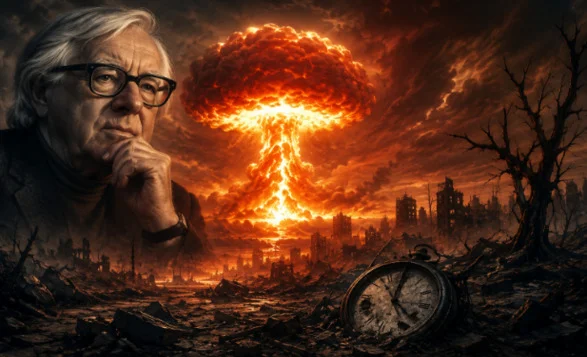
Ray Bradbury predicted August 5, 2026 as the end of the world. Why are readers talking about his prophecy again?
As August 5, 2026, approaches, interest in one of Ray Bradbury’s most famous stories has surged across the internet. Readers are once again discussing There Will Come Soft Rains, a short story published in 1950 (Wikipedia) that describes a world destroyed by nuclear war and gives a specific date for the catastrophe.
While few people see it as a real prediction, the coincidence has sparked renewed curiosity because many of the technologies Bradbury imagined decades ago now exist in everyday life.
The story has become one of the writer’s most discussed works. It raises questions about artificial intelligence, smart homes, nuclear weapons, and the future of humanity. More than seventy years after its publication, many readers are surprised by how closely some of Bradbury’s ideas resemble modern technology.

How Ray Bradbury imagined the future decades before modern technology
There Will Come Soft Rains is set in the fictional California city of Allendale after a devastating nuclear attack. The people are gone, leaving behind only the burned silhouettes of a family on the outside wall of their home. The city is silent, yet one fully automated house continues to operate exactly as it did before the disaster.
Every morning, electronic voices announce the date and time. Automatic kitchen systems prepare breakfast. Robotic cleaning machines move from room to room collecting dust. Mechanical devices open and close doors, while interactive walls continue to display stories for children who no longer exist.
The house follows its daily routine with perfect precision. It never realizes that its owners have died. Bradbury presents technology as efficient but completely incapable of understanding human life or loss.
Eventually, a fire starts inside the empty building. The automated systems fight desperately to save the house. Sprinklers activate, robotic devices rush to extinguish the flames, and emergency mechanisms work until their resources are exhausted. One by one, the machines fail. By sunrise, only a single wall remains standing.
From the ruins, a calm mechanical voice continues repeating the same message: “Today is August 5, 2026.” This final scene has become one of the most memorable endings in science fiction and continues to fascinate readers today.
VIDEO. The classic 1984 animated adaptation of Ray Bradbury’s There Will Come Soft Rains. The short film faithfully recreates the haunting story of an automated smart home that continues operating after humanity has been wiped out by nuclear war.
The reason the story attracts so much attention is not the date itself. It is the remarkable accuracy with which Ray Bradbury described technologies that did not exist in 1950.
Today, millions of people use voice assistants to control lights, music, and household appliances. Robot vacuum cleaners clean homes automatically. Smart ovens, climate control systems, security cameras, and connected devices communicate through the Internet every day. What once sounded like science fiction has become part of normal life.
Many technology experts consider Bradbury one of the writers who best anticipated the development of the modern smart home. Although he never claimed to predict the future, his imagination accurately captured how automation would eventually become part of everyday living.
The approaching date has naturally led to renewed discussions on social media. Some users describe the story as a prophecy. Others see it as a powerful warning about the dangers of nuclear war and humanity’s growing dependence on technology. Literary scholars generally agree that Bradbury intended the story as a cautionary tale rather than a prediction of a specific future event.
His message remains relevant today. Technology can improve everyday life, but it cannot replace human judgment, compassion, or responsibility. Without people, even the most advanced machines continue performing meaningless tasks in an empty world.
More than seven decades after its publication, There Will Come Soft Rains remains one of the most influential science fiction stories ever written. Whether readers view August 5, 2026 as a coincidence or a symbolic warning, Bradbury’s vision continues to inspire debate about artificial intelligence, nuclear conflict, the future of civilization, and humanity’s relationship with technology.
Previously, scientists reportedly calculated the exact date of the end of the world on Earth. Experts claim that the main cause of the end of the world will be a lack of air on Earth. In the future, the Sun will gradually begin to expand. This will cause an increase in temperature, which could change the composition of the atmosphere and reduce the amount of oxygen.