Mysterious Asteroid Accelerates in Space, Puzzling Scientists
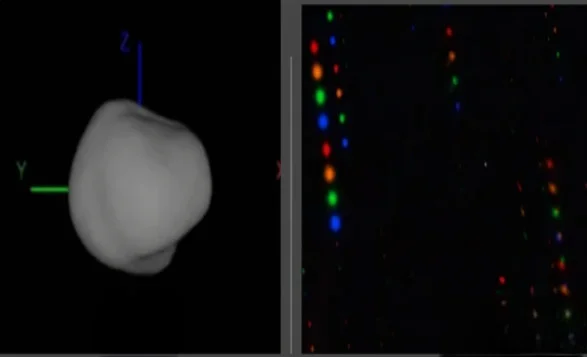
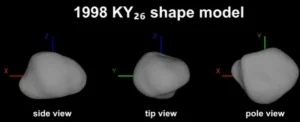
As science knows, most asteroids in space follow predictable trajectories around the Sun. This asteroid motion can be calculated using gravity and other known forces. But one small space rock continues to defy these expectations. Asteroid 1998 KY26 appears to be accelerating in an unusual way, raising questions about what might be influencing its trajectory.
This mysterious object measures only about 11 meters. Despite its modest size, it has attracted the attention of scientists because its motion resembles that of a comet. Astronomers have investigated whether invisible gas escaping from its surface could be the cause. However, a new study suggests this explanation may not be valid.
Comets contain ice, which can turn directly into gas when heated by sunlight. This process, known as sublimation, releases material into space. The escaping gas creates a small amount of thrust, gradually altering the comet’s motion. This was reported by ScienceAlert, citing new research published in the journal Icarus.
Some objects, known as dark comets, behave similarly but lack obvious tails or glowing clouds. Their activity is difficult to detect. They can appear like ordinary asteroids, yet experience subtle accelerations caused by hidden gas emissions.
Researchers considered whether 1998 KY26 belongs to this unusual group. Its trajectory exhibits acceleration perpendicular to the orbital plane. This behavior suggested that invisible outgassing could be a possible explanation.
However, aerospace engineers Corbin Hansen and Masatoshi Hirabayashi of the Georgia Institute of Technology investigated whether the asteroid might actually retain the ice necessary for this process.
Their temperature models combined information about the object’s size, orbit, reflectivity, and probable composition. The results pose a serious problem for the dark comet hypothesis.
Even the coldest regions of 1998 KY26 are estimated to have averaged temperatures of about minus 61 degrees Celsius during its orbit. Much lower temperatures are required for water ice to persist over geological timescales. The researchers calculated that the buried ice would disappear too quickly to explain the asteroid’s long-term behavior.
If only 1 percent of its mass consisted of water ice, this material could disappear in just over 2,000 years. If ice were the cause of the observed acceleration, it could be depleted in about 62 years.
What could be pushing this mysterious space rock?
One possible explanation is solar radiation pressure, as solar radiation exerts a tiny force on objects in space. For a sufficiently small asteroid, this influence could potentially alter its trajectory.
However, scientists have not yet determined that sunlight is the cause of 1998 KY26’s unusual acceleration. The object still holds important unanswered questions about its composition and motion. A more thorough study may eventually provide answers.
The Japanese spacecraft Hayabusa2 is en route to the asteroid, scheduled to rendezvous with it in July 2031. Until then, this small space rock remains an intriguing reminder that even objects in our own solar system can behave in unexpected ways.
Video. Japan’s Hayabusa2 spacecraft: a remarkable mission to explore another asteroid, Ryugu. (English subtitles)
It was also previously reported that our planet Earth has acquired a new temporary Moon. The mysterious asteroid 2026 QQ8 will orbit our planet until early 2027, after which it will fly off into space.