Earth’s New Mini-Moon: Asteroid 2026 QQ8 Captured by Gravity
Earth has acquired a temporary cosmic companion—a tiny asteroid trapped in our planet’s gravity. The object, designated 2026 QQ8, orbited Earth for several months before astronomers determined its unusual trajectory. Although orbital calculations suggest it resembles a second satellite, this rocky visitor will not remain near our planet forever.
This discovery is particularly exciting because such temporary satellites are difficult to detect. Their small size, weak reflected sunlight, and complex trajectories make them challenging for astronomical observation. Scientists often discover these objects only after analyzing their motions and reconstructing earlier encounters with Earth.
This phenomenon occurs when a small asteroid approaches Earth at the appropriate distance and relative velocity. The gravitational pull of our planet can temporarily alter its trajectory, allowing the object to orbit Earth before eventually leaving it.
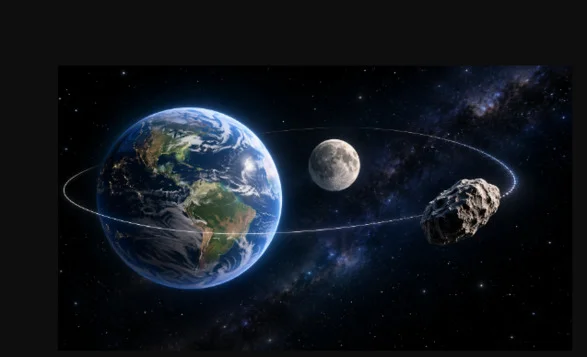
This animation, created by amateur astronomer Tony Dunn, shows the orbits of mini-moons as they are captured by Earth’s gravity, making strange loops around the Earth before escaping again. The rounder white path is the moon orbiting the Earth.
Astronomers call such visitors temporarily captured objects, or mini-moons. Unlike our permanent Moon, they typically follow unstable trajectories and remain gravitationally bound for relatively short periods. Some complete several orbits around Earth, while others leave Earth without completing a single orbit.
Asteroid 2026 QQ8 is approximately two meters in diameter, making it extremely small compared to Earth’s natural satellite. Its current trajectory places it within Earth’s gravitational field, although its temporary orbit differs significantly from the Moon’s stable orbit.
According to orbital calculations, the asteroid orbits the Sun approximately once every 359 days. Its path repeatedly brings it close to Earth, creating opportunities for future encounters even after its current temporary capture ends.
VIDEO. Earth Has a New Moon? Astronomers Spot Tiny Asteroid in Earth’s Orbit.
Why the Mysterious Visitor Won’t Stay
Earth’s gravitational influence is strong enough to temporarily capture small objects, but it can’t always hold them indefinitely. The combined gravitational influence of the Sun and other celestial bodies eventually affects their trajectories, allowing temporary satellites to escape Earth.
Scientists expect asteroid 2026 QQ8 to leave Earth’s gravitational environment in December 2026. After that, it will continue in its independent orbit around the Sun, potentially returning to our planet during future encounters.
The asteroid is expected to remain at a significant distance from Earth throughout its visit. The distance to the closest satellite is estimated at approximately 568,000 kilometers, which is greater than the average distance between Earth and the Moon.
This discovery also highlights how dynamic Earth’s cosmic environment can be. In recent years, astronomers have discovered several temporary satellites, demonstrating that our planet occasionally captures small asteroids moving through the solar system.
One particularly notable example was asteroid 2024 PT5, which attracted considerable attention after becoming a temporary companion in 2024. Researchers studied its trajectory and characteristics, demonstrating how modern astronomical research can detect previously undetected objects.
Animation of 2024 PT5 around Earth – Close approach 2024 PT5 · Earth · Moon. Source: Wikipedia.

Author: Phoenix7777 – Own work Data source: HORIZONS System, JPL, NASA, CC BY-SA 4.0.
These discoveries are scientifically valuable because temporarily captured asteroids provide an opportunity to study small rocky bodies passing relatively close to Earth. Their composition, trajectories, and gravitational interactions can help researchers understand the evolution of the Solar System.
This final visitor will eventually disappear from Earth’s immediate gravitational field, leaving our familiar Moon as a permanent natural satellite. Nevertheless, 2026 QQ8 serves as another reminder that our planet sometimes acquires unexpected companions, even if their visits last only a few months.
It was previously reported that scientists searching for extraterrestrial life had detected a mysterious radio signal. The mysterious signal came from a distant star system with three planets and a potentially habitable world, K2-155. The researchers used a new program of observations collected by China’s massive FAST radio telescope.