Ancient mammal fossil surprised scientists: a small animal that lived 120 million years ago
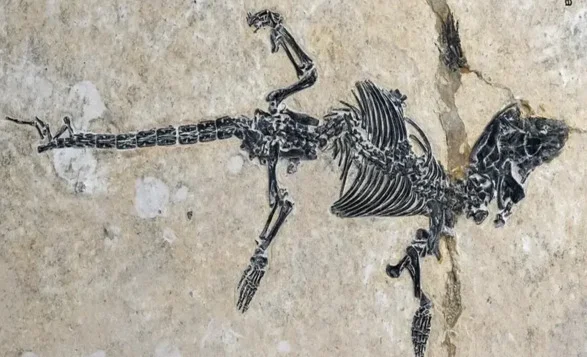
Deep within the fossil-rich rocks of China, paleontologists unearthed a truly extraordinary prehistoric creature. Found in Liaoning Province, this tiny animal lived 120 million years ago, right alongside colossal dinosaurs. Modern high-resolution scanning technology soon revealed biological secrets hidden deep inside its fossilized jaw.
The creature also possessed rare physical adaptations for navigating murky freshwater environments with high agility. Scientists named the species Dongoconodon platycauda, and its discovery completely reshapes our understanding of early mammals.
For decades, evolutionary science taught a very clear rule about mammalian dental development. Most living species grow baby teeth, which are later replaced by a permanent adult set. This classic two-stage cycle, known as diphyodonty, was considered a defining trait of mammals.
However, Dongoconodon platycauda completely disrupted this fundamental biological principle.
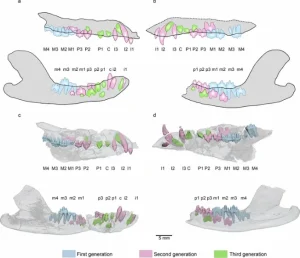
An international research team led by Shundong Bi analyzed the fossilized jaw with advanced CT scans. Inside the bone, scientists observed active replacement teeth positioned beneath fully grown adult crowns. Even more surprisingly, a third generation of developing teeth was forming underneath those replacements.
This continuous tooth renewal pattern, known as polyphyodonty, typically occurs in ancient reptiles. Finding such a complex mechanism in an early mammal raises intriguing questions about its diet and hunting habits.
A Strange Aquatic Shadow in the Age of Dinosaurs
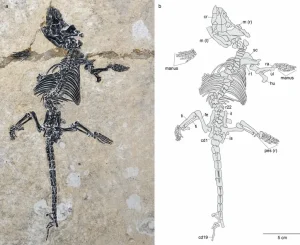
Unusual teeth were not the only evolutionary surprise hidden within this ancient skeleton. Further anatomical analysis confirmed that the animal was a highly specialized aquatic predator, weighing under 200 grams.
Its skeletal structure preserved distinct physical traits specifically adapted for hunting underwater:
- Webbed digits: Flexible hands and feet helped the animal paddle efficiently through rivers.
- Flattened tail: A broad, paddle-shaped tail provided strong propulsion in deeper currents.
- Eardrum features: Intact cartilage provided vital evidence regarding the evolution of mammalian hearing.
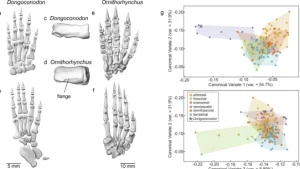
This prehistoric swimmer occupied an ecological niche similar to a modern platypus. Researchers suspect its endless tooth supply allowed the animal to continuously replace crowns damaged while catching struggling prey.
Published in Nature Communications, this discovery proves that early mammal evolution was surprisingly diverse. Cretaceous species were conducting radical biological experiments long before modern families appeared on the planet.
A single well-preserved fossil demonstrates that ancient Earth harbored far more strange creatures than previously imagined. As analytical technology improves, scientists will undoubtedly unlock even more forgotten biological mysteries.
We previously reported on mysterious predatory fish capable of moving on land. These species have a pulmonary system that allows them to breathe directly from the atmosphere. They have begun to take over US rivers, and authorities are calling on people to fight back and behead them.