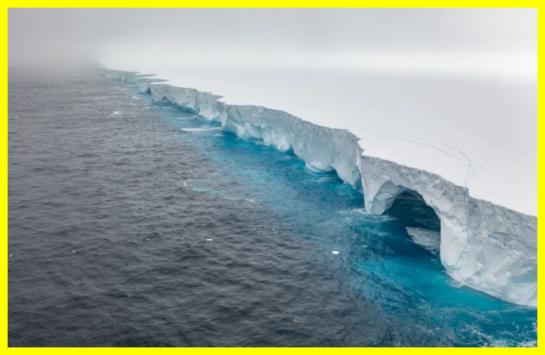
The world’s largest iceberg continues to break apart
It has been reported that the largest iceberg on the planet, A23a, has split again, with four massive pieces breaking off.
As a result of the split, its area has decreased by almost 20 percent.
The iceberg now covers an area of about 1,423 square kilometers, remaining the largest of all known icebergs.
Experts note that the broken-off fragments, with a total area of more than 800 square kilometers, are moving independently.
A23a itself is drifting north of South Georgia Island, and individual fragments have been carried away by southwesterly currents.
These ice masses do not pose a danger to shipping: they are large enough to be reliably detected by ship radars.
The melting process also does not affect the ocean level – melting occurs gradually, and the water is distributed evenly.
Since its formation in 1986, when the iceberg covered an area of 4,170 square kilometers, it has undergone several phases of disintegration.
For a long time, it remained stationary in the Weddell Sea and then began to drift slowly along Antarctica.