Comet C/2026 A1 (MAPS): A New Kreutz Sungrazer That Could Dazzle in Daylight in 2026
In early 2026, astronomers announced the discovery of Comet C/2026 A1 (MAPS), a fascinating member of the Kreutz sungrazer family.
This solar-grazing comet is on a dramatic trajectory that will bring it extremely close to the Sun, potentially creating one of the most spectacular celestial displays in recent years.
Discovery of Comet C/2026 A1 (MAPS)
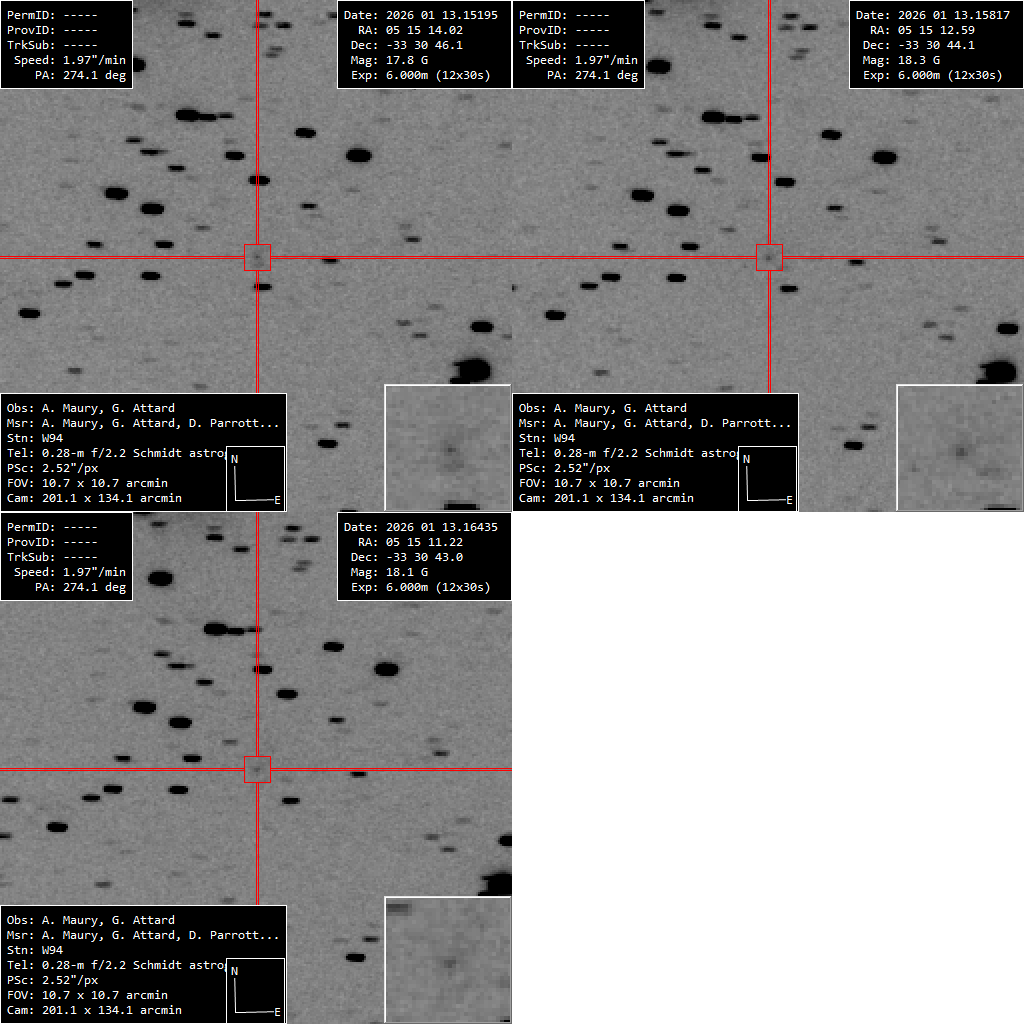
The comet was first spotted on January 13, 2026, by a team of French amateur astronomers: Alain Maury, Georges Attard, Daniel Parrott, and Florian Signoret.
Using a remotely operated telescope at the AMACS1 observatory in Chile’s Atacama Desert, they identified the faint object as part of the MAPS survey (named after the discoverers’ initials).
At discovery, the comet was around magnitude 18—visible only with professional equipment. By February 2026, it had brightened slightly but remained a challenging target for most observers.
Orbit and Close Solar Approach
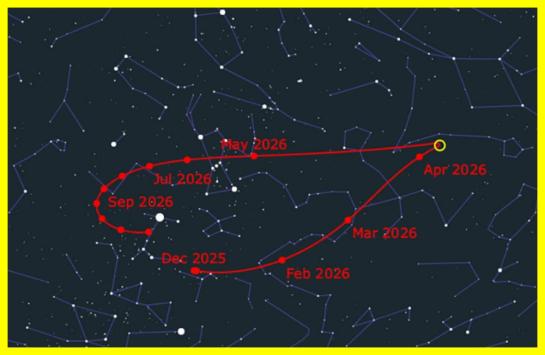
As a Kreutz sungrazer, Comet C/2026 A1 follows a highly elongated orbit with an eccentricity of approximately 0.99995. It will reach perihelion—its closest point to the Sun—on April 4, 2026, passing just 125,000–750,000 kilometers above the solar surface, well within the Sun’s corona.
The orbit also brings it relatively close to Venus, adding to its unique path. Such extreme proximity to the Sun could cause intense heating and outgassing, dramatically increasing its brightness.
VIDEO. IT’S GOING TO HIT THE SUN! (The Biggest Event of 2026)
Will It Become Visible to the Naked Eye—Even in Daylight?
If the comet survives the intense solar heat and gravitational forces, it could brighten dramatically and reach negative magnitude, potentially becoming visible in broad daylight for a short period around perihelion.
Historical Kreutz comets like the Great Comet of 1843 and Comet Lovejoy (C/2011 W3) have produced similar stunning displays.
However, many sungrazers disintegrate completely. The outcome remains uncertain, making this an exciting object for astronomers worldwide.
What Are Kreutz Sungrazers?
The Kreutz family is the largest known group of sungrazing comets, believed to be fragments of a giant comet that broke apart centuries ago.
These objects share similar orbits with high inclination and near-parabolic paths, returning to the inner Solar System after thousands of years.
Comet C/2026 A1 (MAPS) was detected unusually early—months before perihelion—giving scientists a rare opportunity to study its evolution in detail.
This comet serves as a reminder of the dynamic and unpredictable nature of our Solar System. If it survives, April 2026 could deliver one of the brightest cometary events in modern times.
