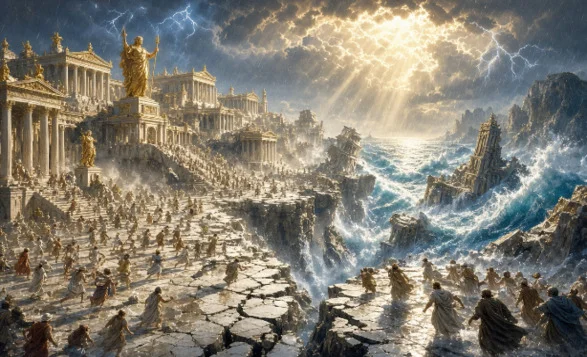
Atlantis: New Ocean Scans Reveal Mysterious Structures
A team of researchers believes new high-resolution maps of the Atlantic Ocean floor could point toward the location of the legendary lost city of Atlantis. The claim has attracted attention because the underwater terrain reportedly contains features that resemble descriptions written by the ancient Greek philosopher Plato.
The project is being led by former US Navy oceanographer Tim Gallaudet. He says researchers have obtained detailed bathymetric data showing unusual formations beneath the Atlantic. The team believes some of these features could correspond to the distinctive layout associated with Atlantis.
Gallaudet discussed the discovery during the American Alchemy podcast hosted by Jesse Michels. He said the researchers believe they have identified a region in the Atlantic containing several formations that appear consistent with Plato’s account. The Daily Mail reports on the team’s plans for a future underwater investigation.
Plato first described Atlantis around the fourth century BC. In his dialogues Timaeus and Critias, he presented Atlantis as a powerful civilization with an unusual capital surrounded by alternating rings of land and water.
The researchers say some features visible in their bathymetric data appear to resemble this arrangement. However, the scans alone cannot establish that the structures were created by an ancient civilization.
VIDEO. On August 24, 2026, retired US Navy Rear Admiral Tim Gallaudet discussed the search for Atlantis. American Alchemy podcast hosted by Jesse Michels.
Researchers plan an expedition to the mysterious site
The exact coordinates remain secret. The researchers say a non-disclosure agreement prevents them from revealing the location before the planned expedition takes place.
The project reportedly involves an emergency physician who has spent more than a decade collecting geological information about the Atlantic region. Physicist Max Derakhshani has also joined the project and is developing an algorithm designed to identify unusual patterns in underwater terrain.
The team hopes to investigate the suspected site using remotely operated underwater vehicles. Such equipment could capture detailed images and geological samples without requiring divers to reach extreme depths.
Deep-sea explorer Victor Vescovo has reportedly shown interest in the project and offered access to a vessel capable of supporting an expedition. His involvement could provide the team with the technology needed to examine the seafloor directly.
One possible location discussed publicly is the Azores Plateau. Some Atlantis theories place the legendary civilization somewhere around the Azores because of the area’s complex geology. Gallaudet, however, has not confirmed that the plateau is the location identified by his team.
Modern geology presents major challenges for traditional Atlantis theories. Scientists have found no evidence of a continent-sized civilization disappearing beneath the Atlantic during human history. The current claims therefore remain unverified until the underwater formations can be examined directly.
VIDEO the 5th Kind. The Lost City Of Atlantis | Full Documentary.
If the expedition confirms that the unusual structures are artificial, it could generate significant interest among archaeologists and historians. Until then, the alleged Atlantis discovery remains an intriguing hypothesis rather than established archaeological evidence.
It was previously reported that archaeologists may have discovered a second Sphinx of Giza. Italian scientists claim to have discovered its hidden twin beneath the sands using new, state-of-the-art radar scanning.