Scientists May Have Discovered a Second Sphinx Under the Sand
A team of Italian researchers led by radar engineer Filippo Biondi announced the discovery of a possible second sphinx on the Giza plateau in Egypt. According to their data, the giant sculpture, carved over 3,000 years ago, may be buried under a thick layer of hardened sand.
Biondi made this announcement on the Matt Beall Limitless podcast. The announcement quickly spread across global media, including the Daily Mail, Newsweek, and LADbible.
According to Filippo Biondi, the researchers conducted an analysis using satellite-based radar technology (SAR—Synthetic Aperture Radar), which records microvibrations of the surface and allows for the reconstruction of underground structures.
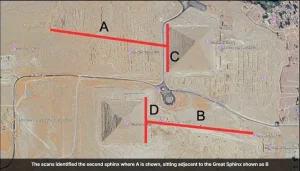
The scientists discovered a mound approximately 55 meters (approximately 180 feet) high, located at a point that is mirror-symmetrical with respect to the Great Sphinx and the Pyramid of Khafre.
“We find a precise geometric correlation… 100% symmetry in this configuration,” Biondi emphasized.
He noted that vertical shafts and horizontal passages similar to those already known beneath the existing Great Sphinx can be traced beneath the hill. The engineer estimates the probability of a second sphinx’s existence at approximately 80%.
Filippo Biondi made this statement on March 26, 2026, on Matt Beall’s Limitless podcast.
Connection with Ancient Artifacts
Researchers are focusing on the Dream Stele—a stone slab installed between the paws of the Great Sphinx around 1400 BC. Some experts believe it depicts two sphinxes, back to back.
This discovery is not the first in a series of claims by Biondi’s team. In 2025, Italian researchers (including Filippo Biondi, Corrado Malanga, and Armando Mei) reported the discovery of enormous underground structures and a possible “megastructure” beneath the Giza plateau using the same technology.
It is important to note that this is only preliminary remote sensing data. No excavations have been conducted at the site, and official Egyptian archaeological authorities have not yet commented on the announcement.
Many Egyptologists are cautious about such sensational claims, emphasizing the need for ground-based verification.
Nevertheless, if the hypothesis is confirmed, it could be one of the most significant discoveries in the study of the Giza pyramid complex in recent decades and significantly change our understanding of ancient Egyptian architecture and symbolism.
It was previously reported that world scientists stated that Tutankhamun’s tomb, which is over 3,000 years old, could collapse at any moment due to damage discovered within it.
Scientists have also managed to unravel the terrible historical mystery of why the ancient Romans had to drive iron nails into dead people.
