New Fluffy Dinosaur Species Doolysaurus huhmini Discovered in South Korea
On March 19, 2026, paleontologists announced the discovery of a new dinosaur species—Doolysaurus huhmini—from a juvenile specimen found on Aphae Island (Aphe-do), South Korea.
Dubbed the “fluffy little dinosaur” or “cute baby dino” in media reports, this early-branching neornithischian is the first new dinosaur species formally described from the Korean Peninsula in 15 years and the first Korean dinosaur fossil to preserve portions of the skull.
The research, led by Jongyun Jung (University of Texas at Austin) and colleagues from the Korean Dinosaur Research Center, was published in the open-access journal Fossil Record.
How the Fossil Was Discovered and Analyzed
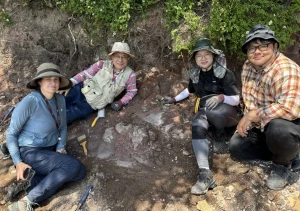
The specimen (holotype KDRC-SA-V001) was collected in 2023 during fieldwork on Aphae Island in the mid-Cretaceous Ilseongsan Formation (approximately 113–94 million years old, Albian to lower Cenomanian).
At first glance, it appeared as a dense, unpromising rock nodule with a few leg bones protruding.
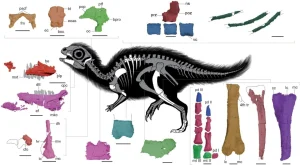
Advanced micro-computed tomography (micro-CT) scans at the University of Texas at Austin digitally extracted and revealed a partially articulated juvenile skeleton, including cranial fragments, teeth, vertebrae, limb bones, and — remarkably — dozens of gastroliths (stomach stones) still in place.
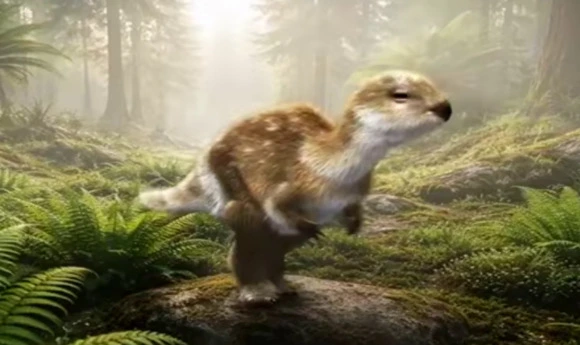
The young individual, estimated at about 2 years old, measured roughly 1 meter (3.3 ft) long — comparable to a large turkey or small lamb. Adults likely reached twice that size.
It was bipedal, with long hind limbs, a balancing tail, and probable filamentous proto-feathers or fuzz covering its body, giving it an unusually endearing appearance for a dinosaur.
Doolysaurus huhmini belongs to the Thescelosauridae, a group of small, early-diverging ornithischians often considered basal relatives of more advanced plant-eaters like hadrosaurs. The preserved teeth and gastroliths indicate an omnivorous diet: ferns, seeds, soft plants, insects, and small animals.
This flexibility sets it apart from strictly herbivorous contemporaries and supports the idea that early neornithischians were adaptable in coastal, humid environments of mid-Cretaceous East Asia.
Why the Name Doolysaurus huhmini?
The genus name honors Dooly (Duli), the mischievous green cartoon dinosaur with twin crests — one of Korea’s most beloved children’s characters since the 1980s.
The species epithet huhmini pays tribute to Professor Min Huh, a pioneering Korean paleontologist who founded the Korean Dinosaur Research Center, discovered the country’s first dinosaur nests, and advocated for UNESCO recognition of Korean fossil sites over three decades.
Phylogenetic analyses place Doolysaurus near the base of Thescelosauridae, clustering with other Asian forms and supporting an East Asian origin or early diversification for the clade.
The find highlights under-sampled small-bodied dinosaurs in Korea’s Cretaceous record, which is otherwise rich in tracks but poor in skeletal fossils. It also reinforces evidence of faunal connections between Asia and North America via land bridges during the Cretaceous.
This discovery suggests that more delicate juvenile fossils may await in similar fine-grained deposits on Aphae Island or comparable Korean sites.
Key Facts About Doolysaurus huhmini (March 2026)
- Scientific Name: Doolysaurus huhmini
- Discovery Location: Aphae Island (Aphe-do), South Jeolla Province, South Korea
- Geological Age: Mid-Cretaceous (Albian–Cenomanian), ~113–94 million years ago
- Specimen: Juvenile (~1 m long), partial skeleton with skull fragments and gastroliths
- Key Features: Bipedal, likely fuzzy proto-feathers, omnivorous diet
- Researchers: Jongyun Jung, Julia Clarke (UT Austin), Min Huh, Hyemin Jo (Korean Dinosaur Research Center)
- Publication: Fossil Record 29(1): 87–113 (2026); DOI: 10.3897/fr.29.178152
- Sources: University of Texas at Austin News, Sci.News, Phys.org, IFLScience, The Guardian, Fossil Record journal
The story of Doolysaurus huhmini blends cutting-edge science with cultural nostalgia — turning a beloved cartoon into a real prehistoric animal. We’ll keep updating on future paleontology breakthroughs from Korea and beyond.
Article based on verified data as of March 21, 2026. For full details, read the original paper in Fossil Record or press releases from UT Austin.