Iran Destroys US E-3 Sentry AWACS in Saudi Strike
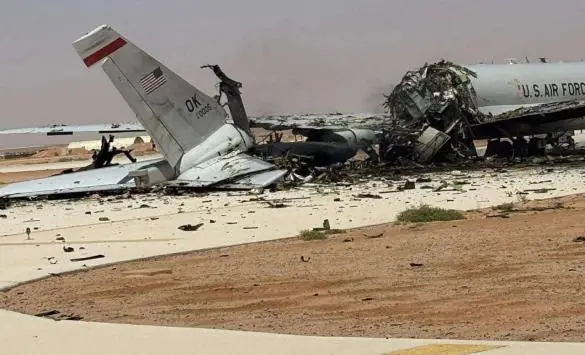
The US Air Force suffered a serious loss during Iran’s recent strike on a US airbase in Saudi Arabia. An E-3G Sentry airborne early warning and control aircraft (tail number 81-0005) was completely destroyed.
American OSINT bloggers have already published photos of the aircraft’s remains, which quickly went viral.
According to preliminary reports, Iranian forces used a combination of ballistic missiles and attack drones. The strike targeted Prince Sultan Air Base, located near Riyadh.
The attack also damaged several KC-135 tanker aircraft and injured 12 to 15 US service members.
Update: https://t.co/61iptqnEjN
— OSINTdefender (@sentdefender) March 29, 2026
Why was the US E-3 Sentry AWACS airborne early warning aircraft targeted?
The E-3G Sentry is one of the US Air Force’s most valuable assets. The aircraft is based on a Boeing 707 and is equipped with a huge rotating rotodome, a 9-meter diameter dome. The rotating radar dome, housing the sensitive antennas of the AN/APY-2 radar system, is located in the rear fuselage.
Iran appears to have targeted the most critical part of the E-3 aircraft. Photos of the remains clearly show that the missile struck the rotodome.
This is no coincidence: the destruction of the AN/APY-2 radar completely disables the AWACS. The aircraft, worth over $500 million (at current prices), is now beyond repair.
American OSINT analysts were the first to release images of the destroyed E-3G Sentry. The footage shows that the rear of the aircraft is completely destroyed. The radar dome is blown away, and the AN/APY-2 antennas are beyond repair.
These images are a true confirmation of the success of the Iranian attack. Previously, Western media reported only “damage to several aircraft,” but visual evidence indicates the total loss of one key AWACS unit.
Implications for the US Air Force and the Region
The destruction of the E-3 Sentry is more than just the loss of a single aircraft. In the current 2026 conflict (the operation against Iran), these aircraft play a crucial role in detecting ballistic missiles, drones, and enemy aircraft. Their numbers in the US Air Force are limited, and new ones have not been produced for many years.
Experts note that the Iranian missile strike significantly reduced US air surveillance capabilities in the Persian Gulf. Now the US is forced to deploy additional forces or rely on satellites and ground-based radars, which are less effective.
