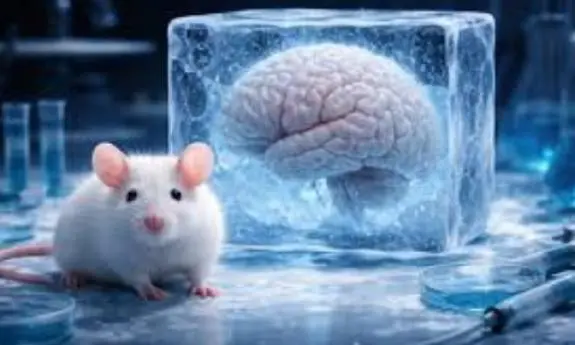
Immortality discovered? Scientists have revived a mouse brain
German researchers have achieved something that only yesterday sounded like pure science fiction. A team of scientists from the University of Erlangen-Nuremberg managed to freeze mouse brain tissue to minus 196 degrees Celsius in liquid nitrogen, transforming it into a glassy state without a single ice crystal—and after thawing, the brain functioned again.
Neurons began transmitting signals, synapses revived, and memory and learning mechanisms returned almost completely. This isn’t just cell survival. It’s a true return to life after all processes had completely stopped.
The breakthrough study was published in the journal Proceedings of the National Academy of Sciences (PNAS). The lead author is neurologist Alexander German. He and his colleagues from the Universitätsklinikum Erlangen have demonstrated for the first time that the brain of an adult mammal can survive such deep cryopreservation and restore functional activity.
Previously, scientists could only preserve the structure or individual cells. Now, full-fledged electrical activity and even long-term potentiation—the very cellular mechanism responsible for learning and memory—have been documented.
How was this achieved? Scientists took thin slices of the hippocampus, a key brain region responsible for memory. They used a special cocktail of cryoprotectants and ultra-rapid cooling.
The water in the cells instantly transformed into a glassy state without forming destructive ice crystals. The samples were stored for anywhere from a few minutes to a week at liquid nitrogen temperature. Then, they were slowly thawed according to a developed protocol.
The results surprised even the authors themselves. After thawing under an electron microscope, all structures—neuron membranes, synapses, dendrites, and mitochondria—remained intact. The neurons again responded to electrical stimuli.
Synaptic transmission functioned almost as well as before freezing. And most importantly, they were able to induce long-term potentiation. In some cases, it was even stronger than in control, unfrozen samples. This means that the memory and learning “program” has not been erased.
The team went even further. They vitrified an entire mouse brain directly inside the skull. After thawing and preparing the slices, hippocampal activity also recovered.
Alexander German explained the essence of the experiment: we wanted to see if brain function could restart after molecular motility had completely stopped in the vitreous state. And it did.
This is the first case in history where not only the structure but also the functioning of neural circuits in an adult mammal has returned after vitrification and long-term freezing. Previously, such successes had only been achieved with very simple tissues or embryos.
Now, a real path to new medical technologies opens: organ banking, brain protection during strokes and severe injuries, and, in the long term, human cryonics.
Of course, complete human “resurrection” is still a long way off. But this experiment has already redefined the limits of what the brain can withstand. Scientists themselves admit: biophysical limits have proven far greater than previously thought. The world of cryonics in 2026 is just beginning.
What’s next: from mice to humans?
Currently, we’re only talking about short-term restoration of functions in laboratory conditions. However, the results give hope that in the coming years, the method will be scalable to entire organs and, possibly, the entire body.
Alexander German and his team are already planning the next steps. If successful, it will be a true revolution in medicine and cryopreservation.
Can humans be frozen using this technology?
Not yet. The experiment was conducted only on mice. Years of additional research, ethical reviews, and scaling up of the method will be necessary before clinical trials on humans can begin.
In experiments, up to a week or more at -196°C. After thawing, neuronal activity and memory mechanisms were fully restored.
This cellular process strengthens connections between neurons and underlies learning and memory formation. If it persists after freezing, it means the brain does not lose its “memory” at the cellular level.
Source: Study by Alexander German et al., PNAS, March 3, 2026. This article is based on official publications and materials from Nature, Scientific American, and other scientific sources.
