NASA Accelerates First Crewed Lunar Orbit Mission for Early 2026 Launch
The U.S. space agency NASA has announced the opening of media registrations for the landmark Artemis II liftoff—the inaugural crewed space exploration endeavor under the initiative to return humanity to the Moon.
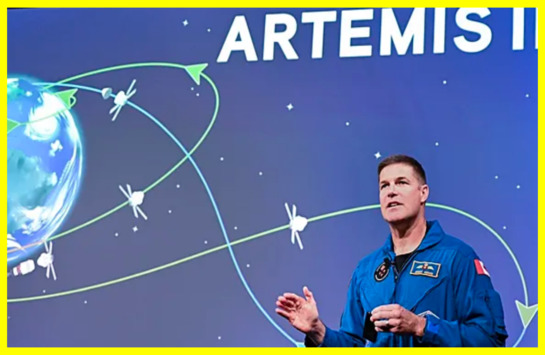
This bold venture, involving four astronauts, is slated for early 2026, potentially as soon as February, spanning roughly ten days to circumnavigate Earth’s silvery satellite without landing.
Recent updates on the Artemis II launch indicate a faster timeline, overcoming prior setbacks linked to Orion spacecraft testing.
In an official post on the X platform, NASA emphasized: “We’re inviting journalists to witness the Artemis II launch, sending four brave astronauts on an exhilarating ten-day orbital journey around the Moon.
The mission is targeted no later than April 2026, with aspirations for February.” This flight marks a pivotal milestone in reestablishing human presence on the Moon, paving the way for upcoming landings and scientific inquiries.
Artemis II Crew: The Astronauts Heading to the Moon
The Artemis II team comprises seasoned professionals who have undergone rigorous training for space operations. Key members include:
- Reid Wiseman – mission commander and veteran of the ISS with extensive experience;
- Victor Glover – pilot, renowned for his contributions aboard the International Space Station;
- Christina Koch – expert in scientific experiments and holder of the record for longest single spaceflight;
- Jeremy Hansen – Canadian astronaut from the Canadian Space Agency, highlighting international collaboration in the Artemis space mission.
This diverse, multinational lineup embodies worldwide cooperation in Moon exploration, with each crew member handling navigation, research observations, and Orion system validations.
Launch Details: SLS Rocket and Kennedy Space Center
The Artemis II will blast off aboard the mighty Space Launch System (SLS) rocket—the most robust platform for demanding space missions.
The departure is set from the iconic John F. Kennedy Space Center in Florida, USA. International media professionals have until November 30, 2025, to submit applications, ensuring ample time for event preparations.
The Orion capsule, equipped with cutting-edge safeguards for crew protection, has cleared key trials following the uncrewed Artemis I in 2022. Fresh insights from NASA suggest a potential speedup to February 5, 2026, contingent on seamless component integration.
The Artemis Program: From Uncrewed Trials to Lunar Landings
NASA’s Artemis lunar program is structured in three phases aimed at sustainable Moon utilization and Mars preparation. Phase one, Artemis I, is complete: in November 2022, the Orion vehicle executed an uncrewed lunar flyby with a safe Earth return, validating core systems.
Phase two, Artemis II, emphasizes human elements: evaluating life support and communications in live scenarios. Phase three, Artemis III, targets astronaut boots on the Moon’s surface by mid-2027, though NASA Administrator Bill Nelson recently hinted at a possible compression to just 3.5 years.
Beyond reclaiming a foothold on the Moon, the program fosters breakthroughs in science, resource extraction, and outposts for interplanetary voyages. Stay tuned to our site for Artemis II launch updates—we’ll cover every step of this groundbreaking space mission.
Sources: Official NASA statements, 2025.