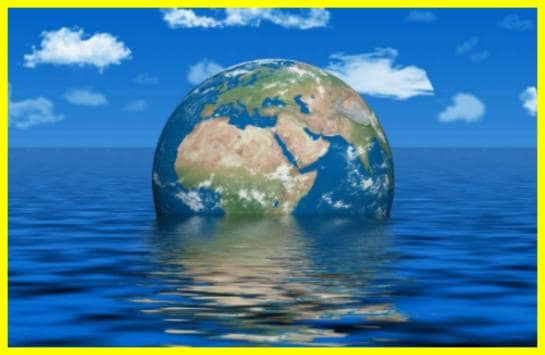
How water got to Earth
Scientists claim the early Earth was too hot to hold ice or water vapor.
Water was originally thought to have formed through geologic activity, but later studies pointed to an extraterrestrial origin.
Now scientists appear to have solved the mystery of where water – an essential element for the origin of life – came from on Earth, Green Matters writes.
The new study offers a convincing model explaining how water came to our planet from space.
Analysis of meteorites has shown the composition of Earth’s water is closest to the water found in carbonaceous asteroids from the belt between Mars and Jupiter.
These asteroids formed in the hydrogen-rich protoplanetary disk that covered the young solar system.
After the protoplanetary disk dissipated, the asteroids began to heat up, which caused the ice to melt or sublimate into vapor.
The water vapor concentrated into gas disks orbiting the Sun. Dynamic processes directed these disks inside the solar system.
And already there, the Earth’s gravity “grabbed” the water vapor. This happened 20 to 30 million years after the Sun was formed.
Mars and Venus also absorbed water but could not keep it because of the lack of defense mechanisms.
The Earth, on the other hand, retained water due to unique conditions – atmosphere and magnetic field.
