Black eggs of unknown creatures have been found in the depths of the ocean
The limits of life in the ocean are set not by biology, but by our technology. The deeper our underwater robots can go, the more astonishing discoveries we make.
Researchers from the University of Tokyo and Hokkaido University found something completely unexpected at 6,200 meters (20,000 feet) depth—shiny black spherical objects that looked like alien eggs.
This groundbreaking discovery, published in the journal Popular Mechanics, has pushed the known depth limit for free-living flatworms (Platyhelminthes) to a new world record.
The Expedition That Rewrote the Rules of Deep-Sea Life
During the KH-23-5 research cruise aboard the Japanese vessel R/V Hakuho-maru, scientists explored the Kuril-Kamchatka Trench in the northwestern Pacific Ocean.
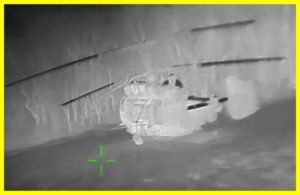
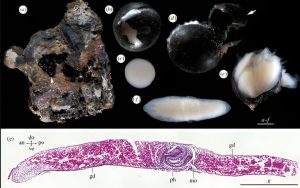
Using a remotely operated vehicle (ROV), Dr. Yasunori Kano spotted several black, perfectly round objects attached to rocky substrate at 6,176–6,200 meters depth.
Extreme Conditions Where Life Should Not Exist
At this depth there is total darkness, water temperature hovers just above freezing (+1 to +2 °C), and pressure reaches 620 atmospheres — equivalent to 620 kilograms pressing on every square centimeter of surface. No sunlight means no photosynthesis; all energy comes from “marine snow” falling from above.
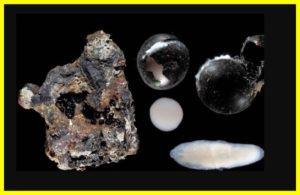
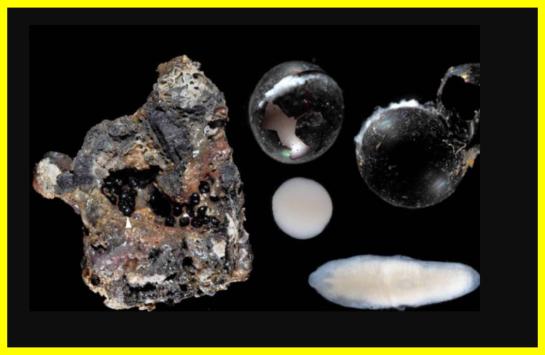
Yet here, on bare rock, the team found clusters of glossy black spheres, each about 3 mm in diameter. Their appearance was unlike any previously known deep-sea egg masses or invertebrate clutches.
What Was Inside the Mysterious Black Eggs?
Most cocoons were damaged during ascent, but four remained intact. When examined under a stereomicroscope at Hokkaido University, they revealed 3 to 7 tiny developing embryos inside thick, multi-layered protective shells — classic cocoons of free-living flatworms (planarians).
DNA analysis confirmed these are a previously unknown species of platyhelminth. The internal anatomy, including a branched gut visible in histological sections, matches the planarian body plan perfectly.
A New Depth Record for Flatworms
Before this find, the deepest known free-living flatworms lived at much shallower depths. Now the record stands at 6,200 meters — the deepest documented occurrence of any free-living platyhelminth on Earth.
Remarkably, these abyssal flatworms look almost identical to their shallow-water relatives, proving that extreme pressure and darkness did not require major evolutionary redesign — only clever adaptations for reproduction and survival.
Why This Discovery Is So Important
- It dramatically expands the known depth range of one of the most resilient animal groups on the planet.
- It proves that complex reproduction (egg cocoons) is possible even in the harshest abyssal environment.
- Flatworms are famous for regeneration — this discovery shows their incredible toughness extends to the deepest ocean trenches.
- Only about 5% of the ocean floor has been explored — countless more species are waiting to be found.
- Flatworms can regenerate their entire body from a tiny fragment.
- Their cocoons provide perfect protection against crushing pressure and predators.
- This is the first direct evidence of flatworm egg masses at true abyssal depths.
- The species is still undescribed — scientists are now working on its official scientific name.
The discovery of black flatworm cocoons at 6,200 meters proves once again that life finds a way even in the most extreme places on Earth. As our technology improves, the deep ocean continues to reveal secrets that challenge everything we thought we knew about the limits of life.
Sources: Biology Letters (Royal Society, 24 January 2024), Popular Mechanics (22 January 2026), University of Tokyo, Hokkaido University, JAMSTEC, IFLScience, ScienceAlert.