Climate change in Antarctica. The fate of the peninsula will be decided in the next 10 years
The Antarctic Peninsula is warming at one of the fastest rates on Earth — average temperatures have risen by about 3 °C over the past 60 years, three times faster than the global average.
A new comprehensive review by British and international climate scientists, published in Frontiers in Environmental Science, models future climate trajectories for the region under low, medium, and very high greenhouse gas emission scenarios up to 2100.
The study uses the latest CMIP6 global models combined with high-resolution regional simulations to assess temperature changes, sea ice loss, surface melt, and the stability of major ice shelves such as Larsen C, Wilkins, and George VI.
Why the Antarctic Peninsula Is Warming So Rapidly Right Now
The peninsula sits in a highly sensitive transition zone influenced by the Antarctic Circumpolar Current, shifting westerly winds, and increasing atmospheric rivers. Recent decades have already brought:
- 40–50 % reduction in winter sea ice extent
- Accelerated surface melting on glaciers
- More frequent rain events instead of snow
- Ice shelf thinning rates of 1–2 meters per year in many areas.
The Critical Decade Ahead: 2025–2035
The authors stress that the next 10–15 years will largely determine the long-term fate of the peninsula’s ice shelves and ecosystems. Even under the most optimistic low-emission pathway (SSP1-2.6, global warming limited to ~1.8 °C):
- Regional mean temperature rise of 1.5–2.0 °C relative to 1981–2010
- 20–30 additional days per year above 0 °C during summer
- 15–25 % increase in surface melt rates
Under medium (SSP2-4.5) and high (SSP5-8.5) scenarios, these changes will be 2–3 times more severe.
Projections to the End of the 21st Century
Low-emissions scenario (SSP1-2.6):
- Regional warming +2.5…+3.5 °C
- Sea ice decline 30–50 % in winter
- Larsen C and Wilkins ice shelves thin significantly but remain largely intact
Very high-emissions scenario (SSP5-8.5):
- Regional warming +5…+7 °C
- Summer temperatures frequently exceed +5…+10 °C
- Larsen C, Wilkins, George VI, and several smaller ice shelves may undergo partial or near-total disintegration
- Contribution to global sea level rise from the peninsula alone: 2–5 cm by 2100 (with much larger long-term potential once marine ice-sheet instability is triggered)
Rapid ice shelf loss would:
- Remove buttressing support, accelerating flow of inland glaciers into the ocean
- Alter ocean salinity, circulation patterns, and nutrient distribution
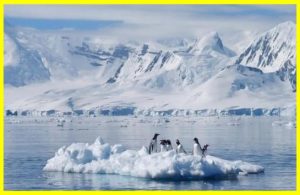
- Threaten krill-dependent species (Adélie penguins, crabeater seals, etc.)
- Increase frequency and intensity of atmospheric rivers and extreme rain-on-snow events.
VIDEO. Antarctica Is Melting: The Climate Crisis Threatening Us All | Award-Winning Documentary.
The Make-or-Break Window: Next 10 Years Are Decisive
Even if global net-zero emissions are achieved after 2050, the heat already in the system will continue driving ice loss for centuries.
The scientists emphasize that aggressive emission reductions before 2035 offer the best chance to preserve key ice shelves and limit the peninsula’s contribution to sea-level rise.
- It is the warmest region of Antarctica — Signy Island recorded +19.8 °C in 1982
- Larsen B ice shelf disintegrated in just 35 days in 2002
- The peninsula has lost more than 300 billion tonnes of ice since 1992
Climate change is already transforming the Antarctic Peninsula into a fundamentally different environment. Without deep and immediate cuts in greenhouse gas emissions, accelerated glacier melt, ice shelf collapse (especially Larsen C and Wilkins), and rising sea levels will become inevitable. The coming decade represents humanity’s last realistic opportunity to avoid the worst outcomes for this critical polar region and the planet as a whole.
Sources: Frontiers in Environmental Science (2025, DOI: 10.3389/fenvs.2025.1730203), British Antarctic Survey, Nature Climate Change, IPCC AR6.