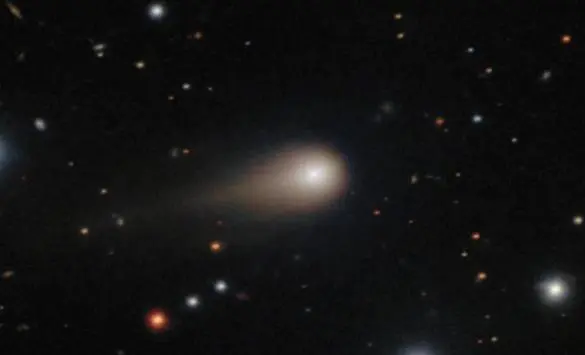
Debris from the interstellar comet 3I/ATLAS: A flurry of fireballs and meteorites has struck Earth
In early 2026, astronomers and amateur skywatchers noted an unusual increase in the number of bright fireballs and meteors.
Many experts attribute this anomaly to our planet passing through a possible debris field of the interstellar object 3I/ATLAS, the third confirmed comet to arrive from beyond the Solar System.
The period at the end of March 2026 was particularly notable. According to data from the American Meteor Society and NASA Fireball Reporting, a record number of bright fireballs were recorded in various regions of the United States, including Washington, California, Ohio, and Texas.
Geophysicist Stefan Burns noted that on March 28 alone, at least 11 bright fireballs flew over Washington. Most of them were moving in the direction opposite the sun, which coincides with the trajectory of Comet 3I/ATLAS.
“The direction opposite the Sun exactly matches the trajectory of the interstellar object 3I/ATLAS during its closest approach to the Sun,” Burns noted.
FIREBALL OVER WASHINGTON STATE MARCH 28th! This marks the 11th fireball event with 100+ observer reports across the USA in the month of March. Many other fireballs have flown in this month as well that have been also similar in brightness, duration, etc but were at really odd… https://t.co/tiGZWR3w9i pic.twitter.com/TnVMw4DBnS
— Stefan Burns (@StefanBurnsGeo) March 30, 2026
Amateur astronomer Drew Doss, known for his comet observations and astrophotography, also commented on the situation on social media platform X.
“Well, this is getting interesting. The fireballs are indeed an as of yet unexplained anomaly. Was I too skeptical? Could we have passed through a 3I/ATLAS debris field?” he said.
Well, this is getting interesting. The fireballs are indeed an as of yet unexplained anomaly. Was I too skeptical? Could we have passed through a 3I/ATLAS debris field?
Sometimes I need to take my own advice.
Stay curious. https://t.co/tlsI77YDRG
— Drew Doss (@drew4worldruler) March 30, 2026
3I/ATLAS is only the third confirmed interstellar visitor after 1I/ʻOumuamua (2017) and 2I/Borisov (2019). Its unusual behavior caught the attention of scientists from the very beginning:
Harvard astrophysicist Avi Loeb, known for his research on interstellar objects, has repeatedly highlighted the unusual characteristics of 3I/ATLAS.
He previously noted that the comet’s behavior differs from that of typical Solar System objects and did not rule out the possibility of an artificial origin, although most scientists consider it a natural comet.
For now, scientists continue to analyze data from the American Meteor Society and satellite observations. A final conclusion regarding the connection between the 2026 meteor shower and debris from 3I/ATLAS has yet to be reached.
However, the very fact of increased fireball activity during the months when Earth is in the comet’s presumed influence zone is prompting the astronomical community to closely monitor the situation.
It was previously reported that, according to experts, the interstellar comet 3I/ATLAS will soon perform another mysterious gravitational maneuver and will likely leave our solar system for good.
