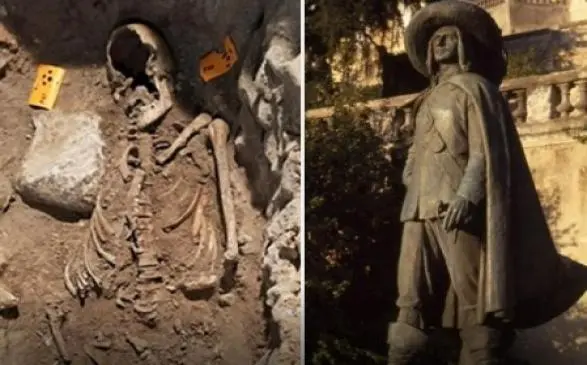
D’Artagnan remains found in the Netherlands: a sensational historical find
In the Dutch city of Maastricht, during renovations to the Church of Saints Peter and Paul, archaeologists made a discovery that could become one of the biggest historical sensations of the year. A male skeleton was discovered under the floor, right next to the former altar.
Scientists highly likely believe these are the remains of d’Artagnan, the legendary French musketeer and the inspiration for the hero in Alexandre Dumas’s novels. The Guardian reports this.
Charles Ogier de Batz de Castelmore, Count d’Artagnan, died on June 25, 1673, during the siege of Maastricht during the Franco-Dutch War. Until now, the exact location of his burial remained a mystery for over 350 years. Now, thanks to the discovery in Maastricht, historians have a real chance of confirming his identity through DNA analysis.
Who is the historical d’Artagnan?
The real d’Artagnan was born around 1611–1613 in Gascony, France. He had a brilliant military career at the court of Louis XIV, rising to the rank of captain-lieutenant of the king’s musketeers and, in 1672, receiving the rank of field marshal.
It was his life that inspired Alexandre Dumas, père, to create the immortal character in his novel The Three Musketeers (1844).
D’Artagnan was more than just a literary hero—he was a real-life commander of an elite unit, close to the “Sun King.”
His death during the storming of Maastricht became a symbol of loyalty and courage. A musket ball wound to the chest or neck ended the legend’s life right on the battlefield.
Details of a sensational discovery in a Maastricht church
Repair work at the Church of Saints Peter and Paul (Petrus en Pauluskerk) in the Wolder district (a suburb of Maastricht) began due to a subsiding floor. During excavations under the altar, workers discovered a skeleton.
In the 17th century, only the most noble and high-ranking people were buried under the altar—just as befitted a Marshal of France.
Key evidence linking the remains to d’Artagnan: a musket ball lodged in the chest area precisely matches the description of the wound from 1673.
A French coin from the 1660s was found near the body.
The burial site is under the altar, where the French army was based during the siege.
Church deacon Jos Valcke, who personally participated in the excavations, stated that he was 99% certain of the find. Previously, historians had speculated that d’Artagnan’s body could have been buried in this village church during the siege of Maastricht.
A DNA test will confirm or refute this hypothesis.
A DNA sample (a tooth) has already been sent to a lab in Munich. There, it will be compared with the genetic material of the de Batz family’s paternal descendants.
Results are expected in the coming weeks. If the test confirms the relationship, it will be a global event and will finally resolve a 350-year-old mystery.
