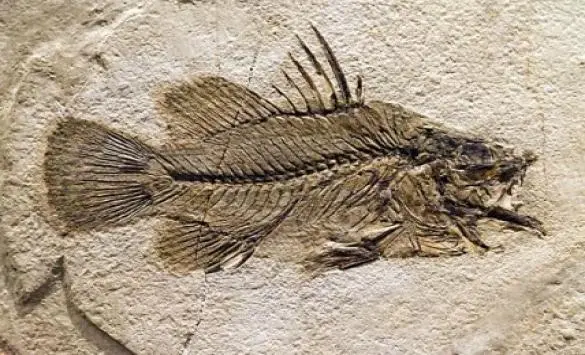
A 244-million-year-old species of ancient fish has been discovered in China
It has been reported that Chinese paleontologists have made an important discovery: fossils of a previously unknown species of ray-finned fish (Actinopterygii) have been found in Yunnan Province.
This species of fish lived on Earth approximately 244 million years ago. The new species has been given the scientific name Ptycholepis huoae.
The fossilized fish, measuring just 27.5 cm in length, was found in marine sediments in Luxi County, Yunnan Province. The find belongs to the extinct genus Ptycholepis, which was previously thought to have existed from the middle of the Triassic period through the Jurassic.
Prior to this discovery, the oldest fossils of the genus Ptycholepis were dated to approximately 242 million years ago and originated from the Monte San Giorgio area on the border of Italy and Switzerland.
Other species of this genus are known from Early Jurassic deposits in Germany, the United Kingdom, and France. Thus, Ptycholepis huoae became not only the first representative of the genus discovered in China but also the earliest in the world.
Ray-finned fish are a vast group of bony fish that today includes almost all modern species, from crucian carp to tuna.
Their ancestors first appeared in the Devonian, but it was during the Triassic period, following a global ecological catastrophe, that they began to actively colonize the oceans.
The discovery of Ptycholepis huoae helps us better understand the early stages of this group’s evolution and the geographic distribution of ancient marine communities.
Scientists continue to study the fossils from Lusi. New discoveries may provide additional insights into the morphological diversity and evolution of Ptycholepis.
For now, P. huoae is officially recognized as the oldest known member of its genus and the first Asian marine ptycholepid.
The study was published on March 30, 2026, in the journal Mesozoic. The authors of the article are an international team led by Professor Xu Guanghui from the Institute of Vertebrate Paleontology and Paleoanthropology of the Chinese Academy of Sciences.
We previously reported on a funny story about a young woman who, while walking along the beach, accidentally found the tooth of a prehistoric creature. The tooth belonged to a megalodon, which lived 3.6 million years ago.
